
With a 60 per cent share of sales, property and plant security is the largest market segment for private security services. Over the last 20 years, numerous new tasks have been added in public spaces, such as in retail, local public transport, as city patrols in municipalities, or for event and public order services. However, there is also an increasing need for security staff in hospitals, public buildings and job centres. The coronavirus pandemic has created additional tasks for the security industry, such as entrance and social distancing checks at public facilities, temperature checks and the protection of security services at vaccination centres. Turnover in the coronavirus years 2020 and 2021 rose by 6.8 and around 9 per cent respectively. Overall, the security industry is expected to generate turnover of more than £10 billion for the first time this year.
The security industry is growing The number of employees has risen from 80,000 in 1990 to around 260,000. Of these, around 25,000 work in aviation security and 10,000 in cash and valuables services. In addition, there are 4,000 detectives and 9,000 employees in surveillance and alarm system companies, a market segment that is becoming increasingly important. Against the backdrop of these distinctions, around 212,000 security personnel are employed in “traditional security services”, 130,000 of whom work for the 1,000 member companies of the Federal Association of the Security Industry (BDSW). The BDSW is the only employers’ association in the industry that concludes collective agreements with the trade unions.
I assume that the importance of the security industry will continue to grow in the future. The need for protection among citizens, businesses, the state and state institutions will continue to increase. Personal precautions are also becoming increasingly important in security matters. Security personnel are increasingly being deployed to protect their fellow human beings in “conflict-prone” activities and are therefore often exposed to an increased risk of accidents at work themselves. The propensity for violence in society is increasing. Figures from the statutory accident insurance show that more and more employees in the industry are becoming victims of “confrontational accidents”. To prevent these, a number of measures have been introduced and are now part of the accident prevention regulations. Body cameras could also be part of this package of measures in the future.
What does the accident prevention regulation for security and guard services entail? In Germany, the statutory accident insurance (DGUC) plays a major role in occupational safety. It is financed exclusively by employer contributions. In order to protect the safety and health of employees and prevent accidents at work, the DGUV issues accident prevention regulations that specify preventive measures and employer obligations. These regulations also indirectly influence the type of service provided. The security industry is governed by DGUV Regulation 24 for security and guard services. In addition to eliminating and adequately securing hazardous areas, employees in the security industry are also required to monitor their activities if they are exposed to particular hazards. Furthermore, the properties to be secured must be regularly checked for hazards. When briefing employees on these properties, attention must be paid to specific hazards. In addition, the equipment used by security personnel must be in proper condition. Accidents at work can have a variety of causes, but what is striking is the increase in confrontational accidents, which will be discussed below.
Confrontations as a frequent cause of accidents at work As already mentioned, private security service employees are increasingly being deployed in “conflict-prone” activities, which is also leading to an increase in accidents at work. In the public sector, 5% of accidents at work can be classified as “violence, assault, threat”, compared with 1.8% in the commercial sector. According to the VBG Security Report 2018, which analyses accidents in the security services sector, confrontations as a cause of accidents have increased significantly (1988: 6.8% of accident causes, 2018: 34.95%). This includes all physical attacks on security personnel by third parties. Confrontation accidents are particularly common among store detectives (25%), public transport employees (22%) and security personnel in residential homes or initial reception centres for refugees (18%).

A total of 15,000 people are employed as department store detectives or shopguards. Their main task is to apprehend perpetrators (especially thieves) and record their personal details. Perpetrators often try to flee or become aggressive towards the detectives, who are allowed to use pepper spray in self-defence. In addition to falls and trips while pursuing fleeing thieves, 76% of all workplace accidents fall into the category of “confrontations”. 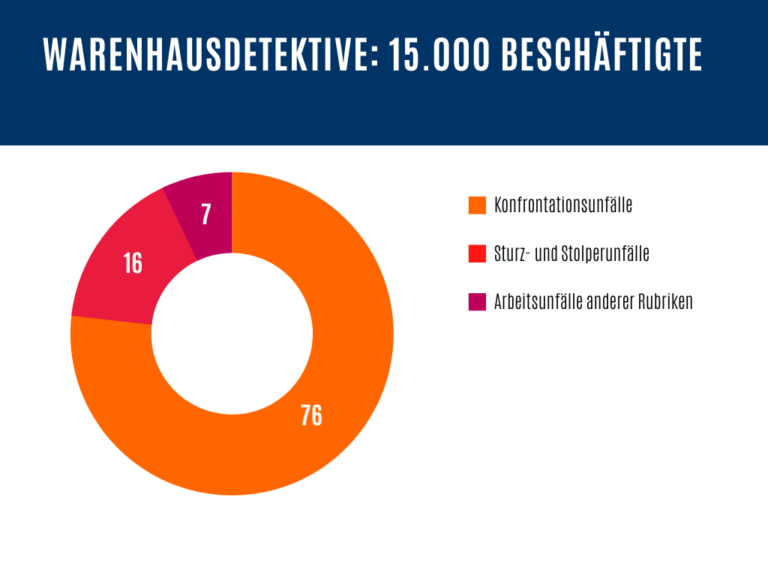

8,000 people are employed in public transport, working in areas such as ticket inspection, accompanying buses, underground and suburban trains, and trains, or monitoring stations and stops. All of these activities can lead to confrontations in which staff are injured. 74% of all accidents in public transport fall under the category of “confrontations”. Staff are particularly at risk when dealing with intoxicated passengers; enforcing house rules also carries an increased risk of confrontation with groups.
The VBG bonus scheme To prevent accidents at work, the VBG professional association has for many years been rewarding its member companies that go beyond their legal obligations and take special measures to prevent accidents and protect health. The maximum amount of this bonus scheme is €10,000 plus 1/1000 of the reported wage and salary sum, up to a maximum of €50,000. Medical and investment costs of 40% are reimbursed. The bonus scheme provides for the following measures, among others: Special driver safety training for patrol and beat officers. De-escalation training for security personnel in conflict-prone activities to reduce stress and keep a cool head in an emergency. In addition, personal protective equipment, including stab and impact protection vests and ankle-high safety shoes, is financially supported by the VBG. Hepatitis A and B vaccinations for security personnel can also be subsidised. An additional part of the bonus scheme includes personal emergency signal systems, accident data storage and collision warning systems. The author has already pointed out to the VBG on several occasions that, when revising the premium procedure, body cameras should also be financially subsidised if the requirements are met, due to their preventive effect. ## What does the DSK guidance from the data protection supervisory authorities say about the use of body cameras by private security companies?
On 22 February 2019, the Data Protection Conference (DSK) published guidance on the use of body cameras by private security companies. It states that the recording of images and sound using a body camera must be in line with a legitimate interest. Before using a body camera, it is therefore necessary to check the purpose for which the body camera recording is to be used. The guidance mentions the following legitimate interests: “The protection of own personnel from assaults, the subsequent identification of a suspect and the securing of evidence for the pursuit of civil law claims”. In contrast, assisting in criminal prosecution does not constitute a legitimate interest in itself for the introduction of body cameras. However, the use of body cameras is possible in situations where individuals are behaving aggressively or a situation is in danger of escalating immediately. In its guidance, the DSK states that it must be objectively justified that body cameras are suitable for achieving the above-mentioned purposes. It questions whether body cameras can effectively prevent crime through a subjectively possible deterrent effect. In addition, a possible provocation effect on potential offenders should also be taken into account. The guidance advises weighing up interests such as personal rights carefully and only using body cameras when their use is appropriate and necessary. It also emphasises the importance of transparency: for example, the persons being recorded should be informed of the use of body-cams before recording begins. ## What needs to change so that body-cams can play a greater role in occupational safety?
Body cameras must be given greater importance in occupational safety, as they are an effective means of protecting employees. It is therefore urgently necessary that they be included as a measure in accident prevention regulations. In addition, more discussions must take place with data protection authorities in order to jointly change the perception of body cameras to a more positive one. There are already numerous examples of body cameras being used in compliance with data protection regulations, and many security staff and their employers report a significant decline in attacks since they started wearing body cameras. Every security officer should be able to draw on these positive experiences so that even more confrontational accidents can be prevented in the future.